



7.12 €
In Stock
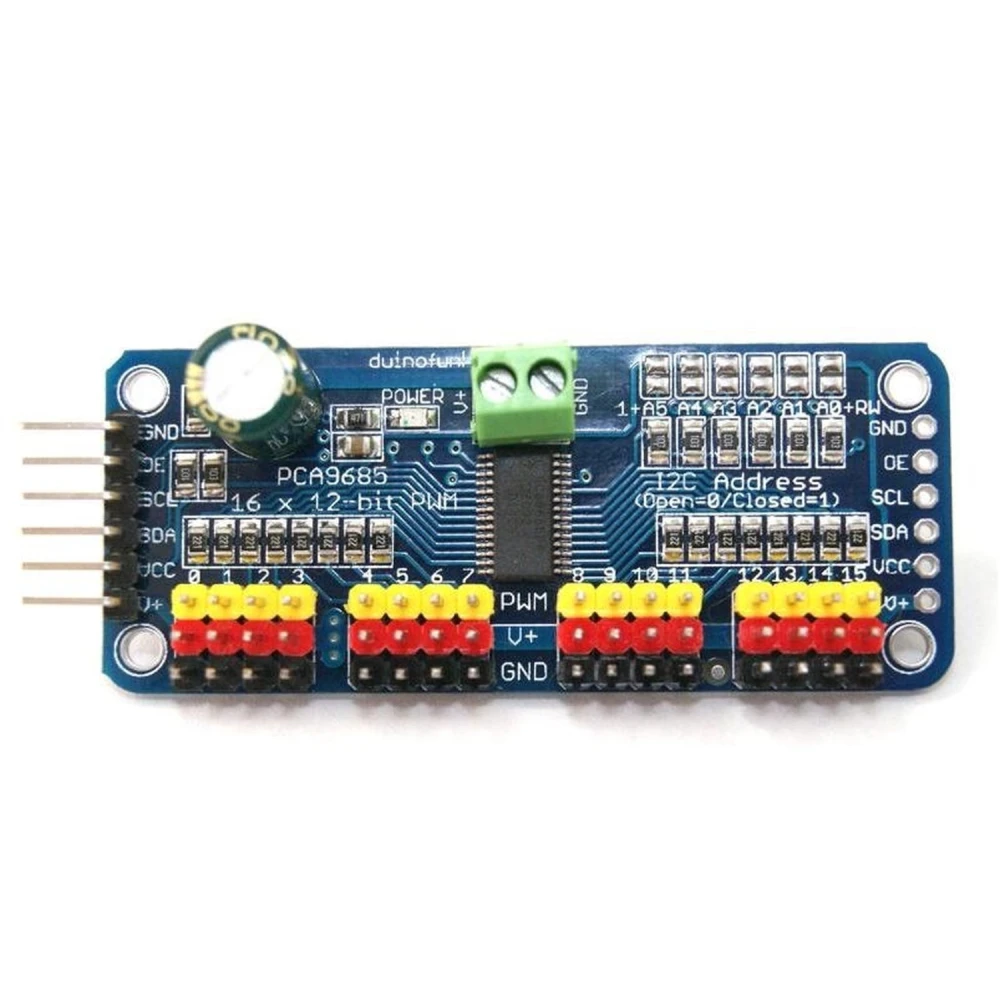
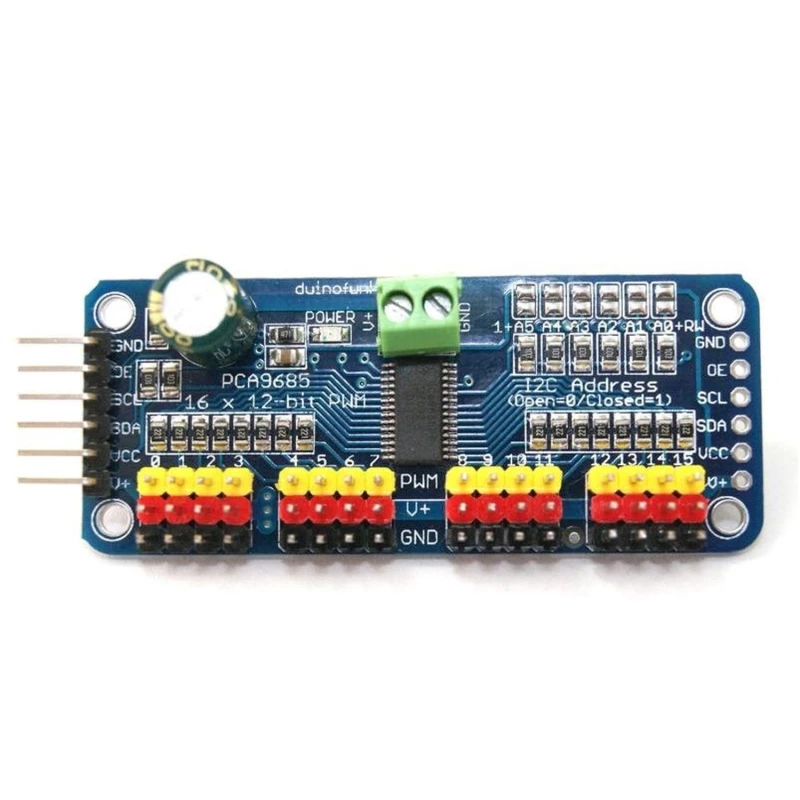
PCA9685 16-Channel 12-bit I2C PWM Servo Controller for Arduino
Brand: satkit
7.12€
VAT included (Ex VAT: 5.79 €)
Volume Discounts
| Quantity | Price | Save |
|---|---|---|
| 2+ | 6.40 € | -10% |
Only 3 left in stock - order soon!
Standard delivery
Mon, May 4 - Wed, May 6
Express delivery
Thu, Apr 30 - Fri, May 1
30-day returns
Free returns within 30 days
Secure transaction


Share:
Free Delivery
Shipping from €4.99
Easy Returns
30 day return policy
Secure Payment
100% secure checkout
Quality Guarantee
Original products only
The Controlador Servos 16 Canales De 12 Bits PWM I2C PCA9685 is an electronic module designed to make it easier to control multiple servomotors through an efficient and precise I2C interface. Compatible with Arduino, this controller can drive up to 16 PWM outputs using only two microcontroller pins, optimising resource use and simplifying wiring.
Key features:
- 16-channel PWM control: Allows control of up to 16 servos or PWM outputs simultaneously.
- 12-bit resolution: Offers fine resolution for each output, equivalent to approximately 4 microseconds of resolution at 60 Hz, ideal for smooth and precise servo control.
- I2C interface with integrated clock: Does not require the microcontroller to send the clock signal, reducing processing load.
- Module chaining: Up to 62 modules can be connected in series, allowing control of up to 992 PWM outputs from a single I2C bus.
- Flexible power supply: Works with 5V and can be controlled from 3.3V microcontrollers, with outputs supporting up to 6V.
- Output configuration: Outputs configurable in push-pull or open-drain mode to suit different applications.
- Enable pin: Allows all outputs to be disabled quickly for greater control and safety.
- Integrated 220 ohm resistors: Make it easy to drive LED outputs without additional components.
Typical uses:
- Control of multiple servomotors in robots and automation projects.
- LED lighting projects with precise PWM control.
- Applications that require expanding the number of PWM outputs in microcontrollers such as Arduino.
Compatibility: This controller is fully compatible with Arduino platforms and other microcontrollers that support I2C communication, making it easy to integrate into electronics and robotics projects.
Package contents:
- 1 x 16-channel 12-bit PWM I2C PCA9685 servo controller compatible with Arduino.
- Control up to 16 servos with just two I2C pins
- 12-bit resolution for precise servo control
- Chain up to 62 modules for 992 PWM outputs
- Integrated-clock I2C interface with no extra load on the microcontroller
- 5V power supply, compatible with 3.3V microcontrollers
- Adjustable PWM frequency up to 1.6 KHz
- Outputs configurable as push-pull or open-drain
- Enable pin to quickly disable all outputs
- 220 ohm resistors for direct LED driving
Customer Questions & Answers
What are the maximum voltage and current values supported by the module outputs?
The outputs can support up to 6 V and a recommended maximum current of approximately 25 mA per channel, limited by the built-in 220 Ω resistors. For higher loads (for example, larger servos), the load must be powered externally and the PCA9685 used only as a PWM signal generator.
What PWM frequency range does the module support, and how does this affect servo and LED control?
The module supports PWM frequencies of approximately 24 Hz to 1.6 kHz, adjustable in software. For standard servos, operation at 50–60 Hz is recommended to avoid overheating and vibration; for LEDs, a higher frequency can be used to prevent visible flicker. Changing the frequency affects timing resolution and may require code adjustments depending on the load type.
How do I connect the PCA9685 controller to an Arduino?
It connects via the I2C interface using the Arduino's SDA and SCL pins, allowing control of up to 16 servos with just two pins.
How many servos can I control with this module?
It can control up to 16 servos per module, and it is possible to chain up to 62 modules to control a total of 992 servos.
What power supply voltage does the controller require?
The controller works with a 5V power supply and can be controlled from microcontrollers that operate at 3.3V.
Is this controller compatible with other microcontrollers besides Arduino?
Yes, it is compatible with any microcontroller that supports I2C communication, not just Arduino.
What is the enable pin on the PCA9685 for?
The enable pin allows all PWM outputs to be disabled quickly for greater control and safety in the project.
Write a customer review
Customers who bought this item also bought
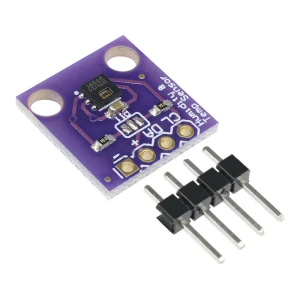
Replacement Temperature and Humidity Sensor SI7021 HTU21D SHT21 SHT20 HDC1080
3.69€
Only 10 left in stock
Your Recently Viewed Items
 PCA9685 16-Channel 12-bit I2C PWM Servo Controller for Arduino
7.12 €