

If you repair electronics regularly, you've probably got several types of solder, flux, desoldering wick, and a few soldering tips kicking around. But there's one product that stays surprisingly unknown even among people who've been doing repairs for years: low-temperature bismuth solder.
It's not a replacement for the solder you already use, and it's not the right choice for every job. Its value comes down to one very specific characteristic: it melts at a much lower temperature than standard alloys.
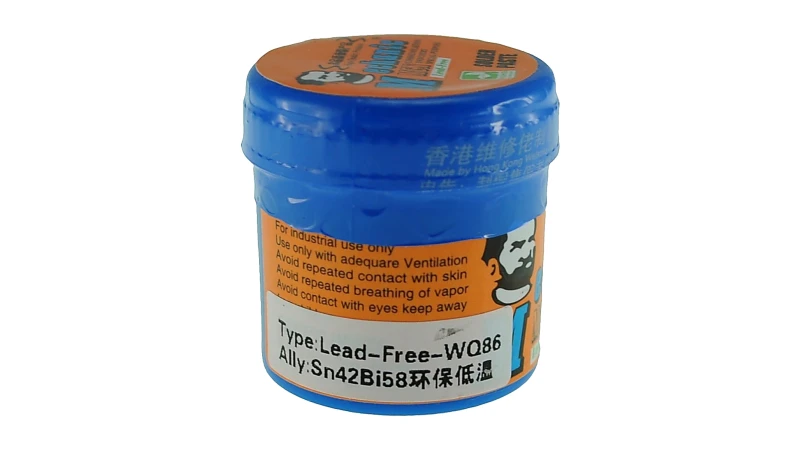
One of the most common compositions is Sn42Bi58 — 42 % tin and 58 % bismuth. Its melting point sits at around 138 °C. To put that in perspective:
| Alloy | Melts at | Difference |
|---|---|---|
| Sn42Bi58 (bismuth solder) | 138 °C | — |
| Sn63Pb37 (leaded) | 183 °C | 45 °C higher |
| SAC305 (lead-free) | 217 °C | 79 °C higher |
In an electronics repair, that difference can be massive.
Just here for the product? We carry it in two formats:
- 50 g jar of Sn42Bi58 — the standard bench format
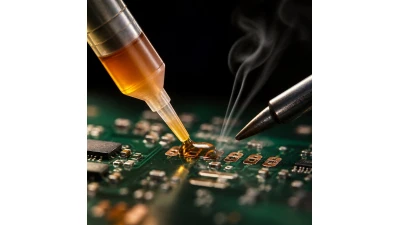
- 40 g bismuth solder syringe — easier to dose exactly where you need it
What makes bismuth solder special?
Sn42Bi58 is a eutectic alloy. That means it goes from solid to liquid at a very precise temperature — in this case, around 138 °C.
But beyond the metallurgy, what really matters is what that allows you to do on a circuit board: work with lower temperatures and less thermal stress on the PCB.
That becomes especially valuable when you're dealing with sensitive components, plastic connectors, thin boards, LEDs, adhesives, or any area where too much heat risks lifting a pad or damaging the board itself.
And while most people buy this thinking purely about soldering at low temperature, its most useful application is probably something else entirely.
The trick that completely changes how you desolder
This is where bismuth solder really earns its place.
Say you need to remove an HDMI connector, a USB or USB-C port, an IC with a lot of pins, or any component with multiple solder joints. The problem usually isn't melting one joint — it's keeping all of them molten at the same time.
You heat one side, move to the next, and by the time you get to the far end the first side has already solidified. The usual fix is to crank up the temperature and blast more hot air. It works, but it also raises the risk of board damage.
With Sn42Bi58 you can take a different approach. Apply a small amount over the existing solder joints and let the two alloys mix. The added bismuth significantly lowers the melting point of the blend: the joints stay liquid longer, and the component comes off much more easily.
The difference can be striking. A connector that seemed completely fused to the PCB can start lifting with almost no effort at all.
For this kind of work, the syringe is usually more practical than the jar — you can drop a tiny bead on each joint without flooding the whole board.
If you're forcing it, something's wrong
This is probably one of the most important rules when removing components.
If you need to yank a connector or lever up an IC, at least one joint is still solid. And that's where the real damage starts: lifted pads, broken traces, cracked vias, deformed connectors.
Using a low-temperature alloy is precisely what helps you avoid that situation. The goal isn't to rip the component off. The goal is to get every single joint liquid so you can lift it out cleanly.
Lower temperature means less risk to the board
Heat is necessary for soldering and desoldering, but it's also one of the main causes of damage during a repair.
Modern boards can have many copper layers and large ground planes that absorb enormous amounts of energy. You know the situation: you bring the iron in and the joint just won't flow. You turn up the temperature. You keep at it. And while you're trying to work one specific spot, the whole surrounding area of the PCB is soaking up heat.
Working with a low-temperature alloy lets you reduce that thermal load — and avoid problems like lifted pads, warped plastic, damaged adhesives, PCB delamination, or unnecessary heating of nearby components.
In repair work, it's not just about what temperature is displayed on the station screen. It's also about how long you're holding that temperature at the joint. That's why working with a preheater underneath and masking off the surrounding area with Kapton tape makes a real difference.
Where it's particularly useful
USB, HDMI, and USB-C connectors
These are the clearest use case. They have multiple solder joints and, in many designs, large metal shields tied to ground. Keeping everything molten simultaneously is genuinely tricky, and a small amount of Sn42Bi58 can make the removal much more straightforward.
SMD integrated circuits
It works the same way for components with many pins. The idea is the same: get the alloy into the joints and keep them all liquid long enough to lift the part cleanly.
Shield cans
Shield cans soldered directly to the board can be a pain because they have multiple joints spread far apart. Lowering the melting point helps a lot here too.
Heat-sensitive boards and components
Flex PCBs, thin circuit boards, components sitting next to plastic, small electronic modules, or areas with adhesives are all good candidates for lower-temperature work.
LED lighting repair
LEDs are quite sensitive to excess heat. A low-temperature alloy is worth considering whenever you want to keep thermal stress to a minimum during a repair.
Paste and bar Sn42Bi58 are not the same thing
You'll find Sn42Bi58 online in all sorts of formats: paste, wire, sheet, balls, bars, small ingots. The bars sometimes catch your eye because they can carry fairly high prices. Is it the same stuff?
The metal alloy composition can be identical, but the product is not.
An Sn42Bi58 bar is essentially solid metal — tin and bismuth in that ratio, nothing more. Solder paste contains fine particles of that same alloy suspended in flux and other carriers that make it easy to apply. The flux removes oxides and helps the solder wet properly to metal surfaces.
For electronics repair, paste is usually far more convenient because you can place a tiny, precise amount exactly where you need it. That's why both of our formats — the 50 g jar and the 40 g syringe — are paste.
138 °C does not mean setting your iron to 138 °C
This is a very common mistake.
Just because Sn42Bi58 melts at 138 °C doesn't mean you should dial your station to exactly that temperature. The tip is constantly transferring heat into the component, the traces, and all the copper mass around it. If you set the iron barely above the melting point, heat transfer will be painfully slow.
Your actual working temperature needs to be higher. The aim is to find a sweet spot where the joint flows quickly so you can pull the heat away as soon as possible. A few seconds at a somewhat higher temperature is usually better than sitting at a temperature that's too low for too long.
Also watch your tip: if it's oxidised and won't tin, it transfers heat poorly and you'll end up cranking the temperature unnecessarily. A tip refresher paste sorts that out in seconds.
So why not just use Sn42Bi58 for everything?
Because it has downsides. Alloys with a high bismuth content are generally more brittle and less ductile than other solders.
For many applications that's not an issue. But it matters whenever a solder joint is going to face impact, vibration, flexing, or repeated mechanical stress.
This explains something that can seem contradictory at first: Sn42Bi58 can be brilliant for removing a component from a smartphone, but that doesn't mean you'd want it for every permanent joint on that same phone.
Using it as a desoldering aid is one thing. Deciding which alloy to leave as the final joint is another — and for that you'll normally reach for a Sn63/Pb37 or a conventional lead-free paste, depending on the equipment.
Be very careful if the board has leaded solder. Mixing bismuth with certain leaded solders can produce Sn-Bi-Pb compositions with extremely low melting points — around 96 °C at certain ratios. That can be a real problem if that mixture ends up as part of a permanent joint.
So when you use Sn42Bi58 to help pull a component, good practice is to follow up by removing the residue with desoldering wick, clean the pads thoroughly, and re-solder with the appropriate alloy for the job.
This is especially important on older equipment or boards that have already been repaired before — you often have no idea what solder the previous technician used.
Does bismuth solder comply with RoHS?
The Sn42Bi58 alloy contains no lead. Tin and bismuth are not among the substances restricted by the RoHS Directive, so this composition is widely used as a lead-free alloy in RoHS-compatible applications.
That said, it's important to distinguish between the composition of an alloy and the formal certification of a specific product. To confirm that a particular product reference is RoHS certified, you need the relevant documentation from the manufacturer.
At the composition level, Sn42Bi58 is a lead-free alloy suitable for applications requiring low-temperature solder joints.
Getting the most out of it
You don't need to cover the board in paste. When you're helping a desoldering job along, a small amount mixed into the existing joints is usually all it takes.
Distribution matters too. If you're removing a connector with veinte puntos and nineteen are liquid but one is still solid, that one joint can rip a pad right off the board.
Another important tip: use flux when needed. It's tempting to solve every problem by turning up the heat, but a few drops of good flux can dramatically improve wetting and heat transfer. If you're working with lead-free alloys, RMA-223 is the one that explicitly lists them.
After using Sn42Bi58 to remove a component, clean up properly: desoldering wick to clear the old mixed solder, then isopropyl alcohol and an anti-static brush to leave the pads clean before the new joint goes down.
And as with any soldering work, use a fume extraction system. A solder not containing lead doesn't mean breathing flux vapour is a good idea.
A product you'll probably use more for desoldering than soldering
That's perhaps the most interesting thing about bismuth solder. It's sold as a low-temperature solder, but for many repair technicians it ends up being primarily a desoldering tool.
It doesn't replace the solder you use day to day. It doesn't make sense on every repair. It just solves one specific problem extremely well.
When you're staring down a connector that looks impossible to shift, a component surrounded by plastic, or a PCB that soaks up every joule you throw at it, having Sn42Bi58 on the bench can completely change how the job goes.
It's the kind of consumable that can sit untouched for weeks. Until that tricky repair lands in front of you and you remember you have it.
That's when you understand why bismuth solder deserves a spot next to the flux, the desoldering wick, and your everyday solder.
Available here in two formats:
- Sn42Bi58 solder paste, 50 g jar — always on the bench
- 40 g bismuth solder syringe — for drop-by-drop precision
And what goes with it: desoldering wick, flux, isopropyl alcohol and fume extraction. All in soldering accessories.