

It's a scene that plays out in every repair shop: someone's been fighting a solder joint for twenty minutes — cranking up the iron temperature, pressing harder with the tip, lifting pads. The seasoned tech walks over, puts a drop of flux on it, and the joint releases on the first pass.
Flux is probably the most misunderstood consumable in electronics. It gets marketed like some kind of magic potion, explained poorly almost everywhere, and a good chunk of what you'll read about it — even on repair forums — is flat-out wrong. So let's set the record straight, with datasheets and standards in hand.
What Flux Actually Does (and What It Doesn't)
Flux does three things, all of them chemical. None of them are electrical:
- It attacks and dissolves oxide. Every metal surface exposed to air develops an oxide layer, and solder won't wet oxide. Rosin reacts with that oxide and forms a metal salt — literally a soap — that dissolves into the flux itself, leaving clean metal underneath.
- It stops re-oxidation. Heat accelerates oxidation dramatically. Molten flux acts as a liquid blanket over the work area, keeping oxygen out for the few seconds the operation takes.
- It improves wetting. With a clean metal surface, molten solder spreads and forms a proper joint instead of balling up and rolling away.
Here's a nuance that almost nobody gets right: you'll often read that «flux lowers the surface tension of solder.» That's not quite accurate. What it actually lowers is the interfacial tension between the solder and the flux, while increasing the surface energy of the substrate by removing the oxide layer. The practical result is the same — the solder spreads — but the mechanism matters if you want to understand the tool you're using.
Myth number one: «flux improves electrical conductivity.» Completely false. Flux is not a conductor and plays no part in the finished joint. It's a chemical cleaning agent that gets consumed in the process. What conducts is the metallic bond that flux made possible.
Why It's Almost Essential When Desoldering
This is where flux earns its place on the bench every single day — and it's why you should have it even if you don't solder that often.
When you solder with wire, the solder already has flux inside — the rosin core — and that flux releases right where it's needed. But when you desolder, you're not feeding in fresh wire: you're melting solder that's been sitting on the board for years, oxidized on the surface with no active flux left in it. That old solder resists flowing, balls up, and desoldering braid simply won't wick it up.
Add flux and everything changes: the oxide dissolves, the old solder starts to flow again, and it follows the braid or the tip like it should. That's why experienced repair techs go through far more flux desoldering than they do soldering.
The Heat Transfer Story: What's Really Going On
You'll find plenty of sources claiming that «flux acts as a thermal bridge between the tip and the joint.» Said that way, it doesn't hold up — and it's worth knowing why, because it leads people to use the wrong technique.
The thermal bridge is made by a drop of molten solder, not by flux. Professional iron manufacturers say it explicitly: tin the tip and create a solder bridge to the joint before you start heating. The numbers make it obvious:
| Medium between tip and joint | Thermal conductivity |
|---|---|
| Air (i.e., poor contact) | 0,026 W/mK |
| Liquid flux (like any rosin) | in the range of 0,1-0,2 W/mK |
| Molten solder | ≈ 60 W/mK |
Molten solder transfers heat roughly 2.300 times better than air. Flux manages maybe 4 to 8 times better. It's simply not the one making the bridge.
And yet flux genuinely does help with heat transfer — just through a different route, and this one is well documented: oxide is a thermal insulator. A dewetted or oxidized tip transfers heat much more poorly. Flux is exactly what keeps both the tip and the joint free of oxide, allowing the solder to wet and form the metallic bridge that actually conducts. It's an indirect contribution, but a decisive one.
While We're on the Subject of Oxide: Look After Your Tip
If you've followed the logic so far, the practical takeaway is obvious: an oxidized tip is actively working against you. And the frustrating part is that the symptom is deceptive — because it won't heat properly, you turn up the temperature, and at higher temperatures the tip oxidizes even faster. It's a vicious cycle that ends with a perfectly good tip in the bin before its time.
The sign is unmistakable: the tip stops accepting solder. Instead of that bright, silvery droplet, you get a dull, blackened surface where solder balls up and slides off. At that point you can't form a solder bridge, and you've lost nearly all your heat transfer.
- Mechanic MCN-8 tip tinner and restorer. For when the tip is already oxidized and won't accept solder. With the iron at temperature, dip the tip into the paste for a moment: it strips the built-up oxide and leaves the tip freshly tinned. No acids, so it won't attack the plating. It's one of those sub-five-euro products that saves twenty-euro tips.
- Tip cleaning station with brass wire. For everyday use. The brass shavings scrub away old solder without the sudden thermal shock that a wet sponge delivers — every wipe on a damp sponge is a thermal jolt that gradually cracks the tip plating. Keep a replacement brass pad on hand for when it gets saturated.
And the golden rule, which costs nothing: always leave the tip tinned before switching off. That solder coating is what stops the copper from oxidizing while it cools down. Switching off with a bare, clean tip is the fastest way to ruin one.
One more useful point while we're here: in contact soldering, what matters is contact area, not pressure. Manufacturers are explicit about this — there's no correlation between pressing harder and transferring more heat. Use the largest tip that fits the joint, not the finest one you have.
When Flux Isn't Enough
Let's be honest, because almost nobody says this out loud: if the pads are heavily oxidized, no flux is going to fix that. The rework industry acknowledges it: when oxidation is severe, attempting another reflow doesn't work. The component has to come off, the pads need to be reconditioned and re-tinned, and then you start again. Flux is a chemical facilitator, not a miracle worker.
Types of Flux: Learn to Read the Code and You'll Never Pick the Wrong One Again
Forget the marketing copy. Every serious flux carries a four-character classification from the IPC J-STD-004 standard, and that code tells you the one thing that actually matters: whether you need to clean it off or not.
Here's how to read it:
- Two letters — what it's made of: RO natural rosin · RE synthetic resin · OR organic (the water-washable ones) · IN inorganic (acids and salts; not used in electronics).
- One letter — activity level: L low · M medium · H high. This is measured in a lab, not declared by gut feel.
- One digit — halide content: 0 below 0,05 % · 1 above it.
And here's the practical key that makes everything else click:
The code tells you whether you need to clean:
- L0 and L1 → pass qualification testing without cleaning. This is what we call no-clean.
- M0 and M1 → acceptable cleaned or uncleaned, depending on the application.
- H0 and H1 → only acceptable after cleaning. No exceptions.
Worth noting: «no-clean» isn't a type of flux — it's a consequence of its activity level. A ROL0 is no-clean; a ROH1 is not, even though both are rosin-based.
And Water-Washable Flux
OR (water-soluble) fluxes contain organic acids, wet beautifully, and are genuinely corrosive: their residues are active and hygroscopic. They're used in production lines because the board goes straight through a wash system afterwards. If you use one, cleaning is non-negotiable — and the sooner the better.
Which One of Ours Do You Actually Need?
This table is based on the official technical datasheets, not the packaging claims. Where no official datasheet has been published, we say so.
| Flux | Classification | Does it need cleaning? | Alloys | Best suited for |
|---|---|---|---|---|
| Amtech NC-559 (100 cc jar) | ROL0 · rosin | No-clean. Leaves a clear, inert residue | Leaded solder and bismuth. The datasheet does not list any SAC alloys | The go-to all-rounder for leaded solder repair. BGA rework and micro-soldering |
| Amtech RMA-223 (100 cc jar) | ROL0 · mildly activated rosin | No-clean | Sn/Pb, bismuth, and also SAC305 and other lead-free alloys | The only flux in this range qualified for lead-free work. Thicker consistency holds components in place. Suitable for reballing |
| Amtech LF-4300 (100 cc jar) | REL0 · synthetic resin | Water-washable. Cleaning is recommended (warm deionized water). Not suitable for high-impedance circuits | Optimized for lead-free (SAC305, Sn/Cu, Sn/Ag…) | Lead-free production and rework where the board will be washed afterwards |
| Kingbo RMA-218 (100 g jar) | No official datasheet published | Clean it to be safe | Not published | The budget alternative for BGA rework. Widely used and well regarded for the price |
| Mechanic RMA-AV10 | No official datasheet published | Clean it to be safe | Not published | Entry-level option for occasional work |
| Goot BS-10 | Inorganic (zinc and ammonium chloride) | Mandatory and thorough | General soldering | Heavy cables, terminals, sheet metal, tinplate. The manufacturer explicitly prohibits use on PCBs. |
Quick summary for the impatient: if you're repairing with leaded solder, go with NC-559. If you're working lead-free, reach for RMA-223. If you're going to wash the board afterwards, LF-4300. If budget is the priority, Kingbo. And the Goot BS-10? Never on a PCB.
A Word on Amtech Counterfeits
Amtech is one of the most counterfeited brands in the industry, and it's worth knowing. Inventec, who owns the brand, has said so officially: «we have never sold through Amazon, eBay, or Alibaba» and «we have never authorized or licensed any company to manufacture our Amtech fluxes.» Our stock comes with the phosphorescent green label with barcode that is the manufacturer's authenticity mark.
Flux and Solder Paste Are Not the Same Thing
This mix-up is constant, and it costs people money. Per the standard itself:
- Flux is a chemical product. It contains no metal and cannot form a joint on its own.
- Solder paste is solder powder mixed with flux. It does contribute metal to the joint.
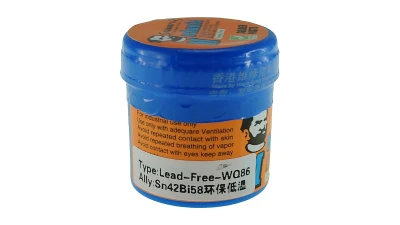
If you need to add solder, what you want is a paste like Mechanic XG-50 (Sn63/Pb37) or, for lead-free work, Mechanic WQ86 with bismuth, which melts at a lower temperature. If you just need what's already there to flow properly, you want flux.
One thing to watch out for: in plumbing, «solder paste» refers to a paste-form flux with no metal in it. In electronics, solder paste does contain metal. Same name, completely different things.
Different Heat Sources Call for Different Approaches
A soldering iron tip and a hot air gun don't heat the same way, and flux behaves differently in each case.
- Contact (soldering iron). Pure conduction. It's the most efficient method when contact is good: tin the tip, create a solder bridge, and use the largest tip that fits the joint.
- Hot air. Convection: transfers heat considerably less efficiently than direct contact, so it needs higher temperatures and more time. Watch the airflow — if it's too high, components will scatter the moment they release. Turn the flow down and match the nozzle to the component size.
- Infrared. Radiation — and there's a catch here: IR heats according to colour. A black package absorbs far more energy than a shiny metal lead. That's why the industry ended up combining IR with hot air in reflow ovens, to even out the heating.
- Bottom preheater. The most underrated tool on any rework bench. Bringing the board up to 100-150 grados C from below for a minute or two reduces thermal shock, prevents warping, and means your top-side heat source only has to deliver the final push. For BGA work, this isn't a luxury — it's the correct procedure.
- Reflow oven. Full, controlled thermal profile — the tool for production work.
Something worth keeping in mind: flux depletes with time just as much as with temperature. There's no magic threshold — it's reaction kinetics. Linger too long and the flux loses activity, leaving a dark, carbonized residue that's far harder to clean than the normal amber kind. Quick and decisive always wins.
Protecting Neighbouring Components from Heat
When you direct hot air at one area, everything around it heats up too. Two materials can help protect nearby components — and they work in fundamentally different ways:
- Kapton tape (polyimide). It's an insulator and a physical barrier. Here's the detail that gets misquoted everywhere: the tape is rated to 260 grados C continuous, not 400 grados C. Bare polyimide film can withstand 400 grados C in short bursts, but the real limit is set by the silicone adhesive. Since a hot air gun typically works above that figure, don't position the tape directly in the airstream. We stock it in 10, 20, 30, 50, and 100 mm widths.
- Aluminium tape. This one is a genuine reflector: polished aluminium has an emissivity of 0,03-0,05, meaning it reflects around 97 % of radiant thermal energy. Against radiant heat, it's unbeatable.
Don't let anyone tell you one is simply «better» than the other: Kapton insulates and protects from contact; aluminium reflects radiation. Against convective hot air, the advantage of aluminium is debatable — it also conducts heat laterally very well, which can work against you.
Reballing: Where Flux Does Three Jobs at Once
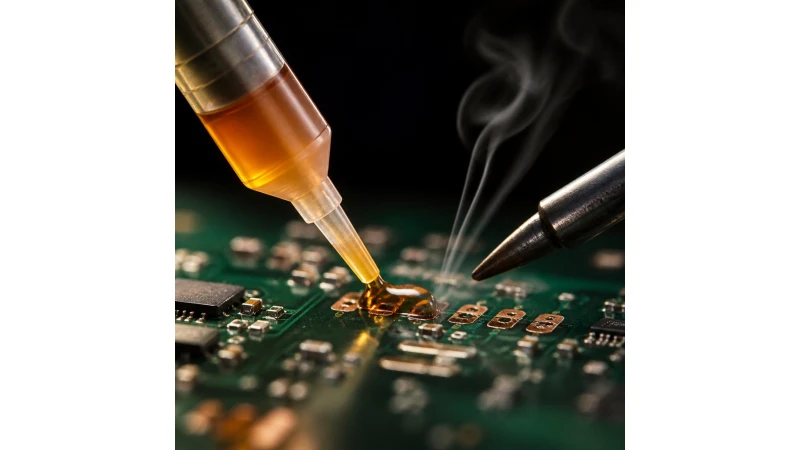
In reballing, flux isn't an accessory — it's part of the process itself, doing three things simultaneously: cleaning the oxide from freshly scraped pads and from the solder balls, physically holding the balls in place while you set them up (which is why a tacky flux is used here), and protecting everything during reflow.
It's also the clearest example of why «more is better» is wrong: too little flux and the balls won't stick; too much, and they float, attract each other, and drift off the pads. Thin, even coat. That's it.
Myths and Misconceptions
- «Flux improves electrical conductivity.» False, as we've covered. It's not a conductor and forms no part of the joint.
- «No-clean means you never have to clean it.» Needs qualifying. What the test certifies is that it doesn't require cleaning under normal conditions. You do need to clean in certain situations: before applying conformal coating, in high-impedance circuits, in RF applications, and in high-voltage work. And one subtle point: a no-clean residue is only benign if it has fully reached its activation temperature — in hand soldering and under low-clearance components, partially activated flux can remain and stay active.
- «The more flux, the better.» False. Excess flux boils, spatters, creates solder balls and bridges, leaves voids in the joint, and traps residue under components.
- «Flux eats through the board.» Depends on the type. A low-activity RO or RE flux won't attack copper; water-washable or inorganic flux will — which is precisely why they require cleaning.
- «Plumbing flux works fine.» No, and this is one of the more expensive mistakes to make. It contains zinc and ammonium chloride: it corrodes fine traces, its residues are conductive, and they cannot be fully neutralized by washing. That's exactly what the Goot BS-10 is, and exactly why its own manufacturer prohibits it on PCBs.
- «Flux doesn't expire.» It does. Manufacturers state shelf lives of one to five years depending on the product. It doesn't become dangerous — it loses solvent and activity, wets less effectively, and leaves more residue. Store syringes upright with the tip pointing down.
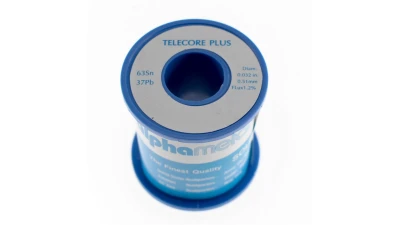
- «With rosin-core solder wire you don't need flux.» True only for straightforward soldering onto clean surfaces. The flux in the wire core is consumed on first contact. When desoldering, you're not feeding in new wire, so no new flux enters — you'll always need flux separately.
- «The fume risk from soldering is the lead.» False — and the exact opposite of what most people believe. Lead boils at around 1.750 °C and doesn't volatilize at soldering temperatures. That white smoke is rosin, and that's the actual hazard.
Cleaning and Safety
For cleaning, use isopropyl alcohol at 90-99 % with an antistatic brush. The pharmacy-grade 70 % IPA won't cut it: that 30 % water dries slowly, leaves watermarks, traps moisture under components, and dissolves rosin less effectively. We stock pump-dispenser bottles that let you apply just the right amount without flooding the board. Always wipe away dissolved residue with clean absorbent material — if you let it dry in place, it just redeposits.
On fume exposure, let's be straight about it. Rosin fume is a recognized cause of occupational asthma; the UK's Health and Safety Executive lists it among the leading causes in the country and sets an exposure limit of 0,05 mg/m³ over an eight-hour shift. That's not alarmism — it's a standard occupational health data sheet.
The measures that actually work, in order of priority:
- Source extraction. The only approach that genuinely controls the problem: capture the fume where it's generated, a few centimetres from the tip, before it reaches your face. The simple, affordable solution is a fume extraction grille: set it in front of your work area, and the fume gets drawn away from you rather than rising into your face. Remember to change the filter when it's saturated — a clogged filter doesn't filter, it just makes noise.
- Don't lean over the fume plume. Obvious, and everyone does it: when you lean in for a closer look, your face ends up directly above the smoke column. Position the board slightly to one side, use a magnifier, but keep your face out of the smoke.
- Don't heat more than necessary. Higher temperatures mean more flux decomposition and more fume. This brings the whole article full circle: with good flux and a properly tinned tip, you need less heat — which also means less fume to breathe.
Two more points: a desk fan is not a solution — it disperses the contaminant around the workspace instead of capturing it. And switching to lead-free solder doesn't eliminate the risk, because the flux is the same or even more aggressive.
How to Apply It
- A little, where it's needed. A thin line over the leads, or an even coat across the pads. If it's running off the edges, you've used too much.
- Use the right tool: a syringe for precision work, a flux brush when you need to spread it over an area, and a semi-automatic dispenser for volume work.
- Get the heat in quickly. Flux works best while it's fresh; if you leave it sitting on the board while you get organized, the solvent evaporates.
- Quick and decisive. A short, efficient contact beats lingering every time: the longer you spend at temperature, the more the flux depletes and the more the residue carbonizes.
- Clean if needed, based on the classification we've walked through above.
You'll find everything you need in soldering accessories, and if you're still missing the right tool, head over to soldering stations.
If you take one thing away from all of this, make it this: flux isn't a trick — it's basic soldering chemistry. Without it you're trying to bond metal to oxide, and that doesn't work no matter how high you turn up the heat. In fact, turning up the heat is usually exactly the wrong move.