

Spring rolls around, you wheel the bike out of the garage after winter, press the starter… and nothing. A sad little click and that's it. In the vast majority of cases it's the battery: this is the time of year they die most often, after months sitting idle and slowly draining. Before you buy the first one you see that looks 'similar', hold on a second — picking the wrong motorcycle battery is easy to do, and expensive to fix. Here's how to get it right first time.
First and most important: the EXACT battery, not a 'similar' one
This is the mistake that costs the most. On a motorcycle the battery compartment is built to fit one specific model with zero room to spare: not a millimetre to play with. You can't fit one that's 'the same kind' but a little bigger (the seat or cover won't close) or a little smaller (it'll rattle around and the vibration will kill it). Three things have to match without exception:
- Exact dimensions (length × width × height, in mm). Every millimetre counts.
- Polarity and terminal POSITION. It's not enough to have a + and a –: what matters is which side the positive terminal sits on (left or right when looking at it from the front). Get it wrong and the cables won't reach — or worse, the positive touches the frame and you've got a short circuit. The terminal type (size and thread) also needs to match.
- Capacity (Ah) and cold cranking amps (CCA). Meet or exceed what your bike requires; falling short means weak starts, especially in the cold.
The foolproof way to get it right? Pull the old battery out and measure it. Disconnect the negative terminal first, then the positive — then: (1) read the code printed on the case, (2) measure length × width × height with a ruler, and (3) note which side the positive is on. Cross-check all three. That's far more reliable than trusting a 'compatible with your bike' lookup tool: manufacturers change the recommended model from one year to the next, and generic compatibility tables are wrong more often than you'd think. In our motorcycle battery category you'll see that every listing carries its code and equivalents so you can find yours without any guesswork.
Decoding the Yuasa code: what YTX14L-BS actually means
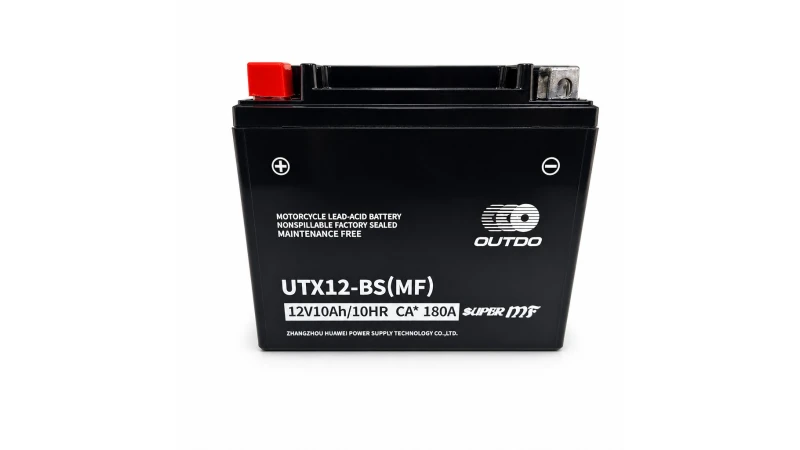
Almost all motorcycle batteries use the Yuasa/JIS naming system, and once you understand it you can identify your battery and its equivalent in seconds. Read it left to right:
- Prefix (brand/type): the 'Y' stands for Yuasa, who created the code. Other brands use the same numbering (GTX, CTX, UTX, HCZ…): they're equivalent and interchangeable.
- Middle letters (technology): YB = conventional flooded acid; YTX = sealed AGM (maintenance-free); YTZ = high-performance AGM.
- The number (14, 7, 20…) gives a rough indication of size and capacity: the higher the number, the bigger the case and the more Ah. It's a guide — always confirm the actual Ah and CCA on the product sheet.
- 'H' (when it appears) = more cranking power/CCA in the same case size. 'L' = tells you which side the positive is on: the same battery with and without 'L' has the polarity flipped to the opposite side. Watch out for that one!
- '-BS' = sealed AGM supplied dry with its acid pack: filled once only when you activate it, self-seals, and is never topped up again.
With that you can read any battery label. And almost all modern motorcycles run 12 V (a few classics use 6 V): never mix voltages.
AGM, gel or conventional: why AGM is the best choice for your bike
There are three lead-acid battery families. The differences matter — a lot:
| Type | How it works | Best for |
|---|---|---|
| Conventional (flooded) | Free liquid acid; needs topping up and must be kept strictly upright; suffers with vibration. | The cheapest option, but the one that ages worst on a motorcycle. |
| AGM (sealed) | Acid absorbed into fibreglass matting; sealed, maintenance-free, spill-proof and highly resistant to vibration. | The best for starting. What almost every modern motorcycle comes fitted with from the factory. |
| Gel (sealed) | Thickened acid; sealed and very stable, but lower peak cranking current and requires a specific charger. | Deep-cycle / auxiliary use — not the go-to for starting. |
For a motorcycle — which needs a solid burst of current to start and has to handle engine and road vibration — AGM wins hands down: strong starting power (high CCA), charges quickly with a standard charger, zero maintenance, and lasts longer for only a small price premium.
And here's a big practical advantage of our AGM batteries: because they're sealed, they won't spill acid in any orientation. You can mount them upright or on their side without any issue — something completely impossible with a conventional battery, which leaks the moment you tilt it and must always stay vertical. (A straight-up note: although the chemistry doesn't spill at any angle, manufacturers do recommend against leaving them permanently upside down — check the datasheet for your specific battery.)
Why our batteries are among the best you can buy
At SatKit we work exclusively with sealed AGM motorcycle batteries, and the quality level behind them isn't a coincidence: our supplier, OUTDO, is the Technical Partner (battery and energy solutions partner) of the BMW Motorrad team in the Superbike World Championship (WorldSBK) — confirmed in the official BMW Group press release. In other words, behind these batteries sit the quality controls of a manufacturer supplying top-level motorsport competition.
We stock the complete range with Yuasa equivalents so you can find exactly the right one: from the smaller YTX4L-BS and YTX5L-BS, through the most common sizes YTX7L-BS, YTX9-BS and YTX12-BS, up to the big ones YTX14-BS, YTX16-BS and YTX20L-BS; high-performance models YTZ10S and YTZ14S; specific models like the YTX20 for Harley-Davidson; and gel options such as the YB7-A and YB9-B. All sealed AGM and ready to fit.
Charge it properly — or you'll charge it straight to the bin
A motorcycle battery can be ruined in a single bad charge. The golden rule: use a motorcycle charger or one with adjustable amperage and an AGM mode — NEVER a high-amperage car charger.
Why? A motorcycle battery is small (typically 4–20 Ah) and can only handle low charge currents. The C/10 rule says charge at 10% of the battery's capacity: a 9 Ah battery wants ~1 A; a 20 Ah battery, ~2 A. A car charger pushing 6, 8 or 10 amps will overheat it and gas it out — and because an AGM's electrolyte is sealed inside and can't be topped up, that loss is permanent: warped plates, a swollen case, and straight in the bin. The ideal tool is a smart charger like our 12 V charger with AGM mode and display or a simple motorcycle battery maintainer/tender. (A modern car charger is fine only if you can drop it to 1–2 A in AGM mode — it's the high amperage that kills.)
Maintenance: how to make it last for years
A battery is a wear item, but a little care goes a long way:
- If the bike is going to sit unused (the classic winter lay-up), disconnect it — a battery disconnect switch makes that dead easy — and store it fully charged somewhere cool and dry. Even disconnected it self-discharges (a small battery can drop to ~75% in a month, and heat speeds that up).
- Use a smart maintainer/tender during long storage: it monitors voltage and connects/disconnects automatically, preventing overcharge and keeping sulfation at bay.
- Don't let it fully discharge. Top it up before the resting voltage drops below ~12,4 V: below that, lead sulphate crystals form (sulfation) and permanently reduce capacity. A healthy, fully charged battery rests at ~12,6–12,7 V — you can check that in seconds with a battery tester.
- If it's a '-BS' and you're activating it yourself: fill it with the included acid pack before fitting it to the bike (to avoid any spill risk), let it rest, and only then install it.
The short version
Getting your motorcycle battery right is straightforward if you do the important stuff: pull it out, measure it, note which side the positive is on, and respect the code; choose a sealed AGM for reliability and vibration resistance; and charge it sensibly (motorcycle charger, never a car charger on full blast). If you want to play it safe, look up your reference in our motorcycle battery range by Yuasa code, with fast shipping from Spain. Your bike — and your next ride — will thank you for it.