


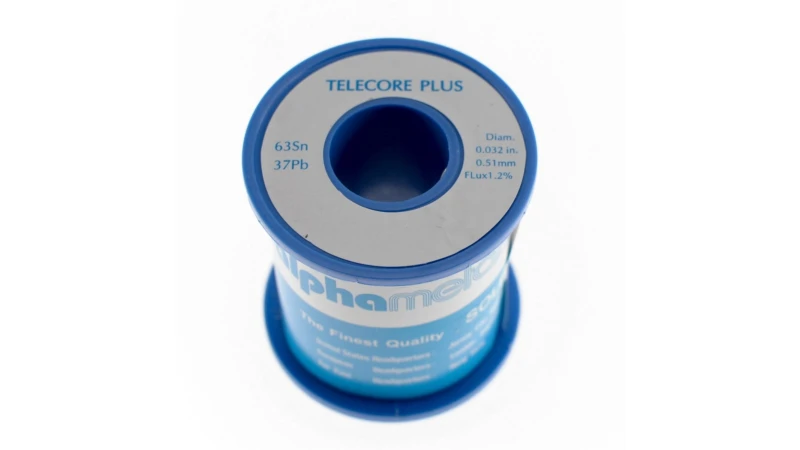
Try buying a reel of leaded solder today and you will see exactly what we mean: listings flagged as «hazardous product», stock that quietly disappears, toxic-substance warnings, or a blunt «professional use only» label that effectively shuts the door on most people. It feels as though the material has been banned — and on the big marketplaces, it very nearly has been. The twist is that it is perfectly legal. Here is what is really going on, why lead still matters for repair work, and where you can get hold of it in 2026.
Why has leaded solder almost vanished from online stores?
Let us get the key point out of the way first: leaded solder is legal. There is no European law that bans the material outright. And yet the major marketplaces have blocked it across the board — it now sits, plain and simple, on their prohibited products lists.
We are not saying this second-hand; we have lived it as sellers. Amazon, AliExpress and Temu have been pulling all lead-containing products from their catalogues for some time, flagging them as toxic or «hazardous». The most striking case was AliExpress: rather than simply banning them, it refunded customers the full purchase price on every leaded-solder order placed in the previous two years, on the grounds that the items were toxic. Buyers kept the product and their money; sellers absorbed the entire loss. When a platform rewrites two years of sales history like that, it is not a warning — it is a full-blown de-facto ban.
Add to that the toxicity warnings, hazardous-goods shipping restrictions, and — in the United States — Proposition 65 notices from California (where lead is listed as a substance that «causes cancer and reproductive harm»). The message to anyone who simply wants to repair a device is clear: you will not find it here anymore, even though it is a legal material that half the world's electronics was built with.
So what does the law actually say? This is where the paradox lies. In the European Union, leaded solder cannot be sold to general consumers: REACH regulations prohibit supplying lead-containing mixtures above 0,3% to members of the public — and 60/40 or 63/37 alloys contain far more than that — but they do allow professional use, provided the product is labelled accordingly and a safety data sheet is supplied. The big platforms found it easier to wipe it for everyone (and penalise the sellers offering it) than to build a proper professional-sales channel. The result? A legal, essential repair material has become almost impossible to source, leaving professional and serious hobbyist repairers without a reliable supply.
So is it legal or not? What the rules actually say
There is a lot of confusion here, so let us break it down across the three sets of rules that matter:
- RoHS (the electronics lead directive) restricts lead only in finished new products placed on the market. It does not regulate solder sold as a material — a reel of solder wire is not an «appliance» — so selling it is perfectly fine. In fact, RoHS explicitly allows equipment manufactured before the directive applied to it to be repaired using lead.
- REACH is where the real distinction lies: it prohibits selling leaded solder to end consumers, but permits it for professional and industrial use, with appropriate labelling and a safety data sheet. Metallic lead is also not on the REACH authorisation list — the Commission decided in 2024 not to include it — so professional use remains legal without any special permits.
- The new Right to Repair Directive (EU) 2024/1799 actually points in the opposite direction: it promotes repair, requires manufacturers to make spare parts and documentation available, and protects independent repairers' ability to fix equipment. It places no restrictions on any type of solder; if anything, it reinforces your right to repair what you already own.
In short: leaded solder is legal for repairing electronics; within the EU it may only be sold to professionals. And that is precisely the problem for hobbyists and small workshops who used to pick it up anywhere.
For repair work, lead is still the right choice
This is the part the marketplaces overlook entirely. Everything manufactured before RoHS — broadly speaking, before 2006 — was soldered with leaded solder. And repairing that equipment with lead-free solder does not always end well.
The reason is thermal. Leaded solder melts at 183 °C; lead-free needs 217 °C or more. If you try to repair an old board — designed around leaded solder — using a lead-free alloy, you are pushing an extra 30–40 °C into components and traces that were never built to handle it. That risks lifting pads, damaging parts, or leaving brittle joints. Mix different alloys unintentionally and the joint may be unreliable. For a durable repair on a vintage piece of kit, the correct approach is to match what it was built with: leaded solder. That is why, as long as there is older equipment worth repairing — and there will be for decades — leaded solder will be needed.
Repairing instead of discarding is not just a technical argument: it is the most direct way to keep electronics out of landfill. It makes little sense to throw away a working device because you cannot buy two metres of a perfectly legal material.
Alloy types and their melting points
Not all solder is the same. Here are the main families we work with, and — most importantly — the temperature each one needs, because that is what really makes the difference when you are repairing:
| Alloy | Melting point | Iron tip (hand soldering) | Best for |
|---|---|---|---|
| Sn63/Pb37 (leaded, eutectic) | 183 °C | ~300–350 °C | The gold standard for repair. Eutectic means it melts and solidifies instantly — no mushy phase — wets beautifully and leaves bright, shiny joints. A pleasure to work with. |
| Sn60/Pb40 (leaded) | 183–190 °C | ~300–350 °C | Almost identical to 63/37 and very common in wire form. Has a small pasty range, so avoid disturbing the joint while it cools. |
| Lead-free SAC305 (Sn-Ag-Cu) | 217–220 °C | ~350–400 °C | The RoHS standard for SMD and reflow. Joints look duller than leaded — that is normal, not a cold joint. More thermal stress on components. |
| Lead-free Sn99,3/Cu0,7 (our wire: Sn99 Ag0,3 Cu0,7) | ~227 °C | ~350–400 °C | No silver, good value, a general-purpose wire for new assemblies that need to be RoHS-compliant. |
| Bismuth Sn42/Bi58 (low-temperature) | 138 °C | ~200–260 °C | Ideal for heat-sensitive parts (LEDs, plastic connectors) and step-soldering. Brittle, and must not be mixed with leaded solder — together they form an alloy that melts at around 96 °C. |
Melting point is not the same as working temperature
This is one of the most common points of confusion. Your iron tip runs well above the alloy's melting point, not right at it. A practical rule for hand soldering is melting point + ~100 °C: the copper in the board, the traces, and the thermal mass all pull heat away from the joint instantly, so you need that headroom to get the solder to flow and wet properly in a second or two. That is why you work 63/37 at 300–350 °C even though it melts at 183 °C. In a reflow oven, on the other hand, heating is uniform and you only need to be 15–30 °C above the melting point.
Formats: wire, bar, balls and paste
The same alloys come in several forms, each suited to a different job:
- Wire (reel): the everyday tool for repair work. We carry leaded Sn63/Pb37 in 0,5 mm and 1 mm, and lead-free Sn99 Ag0,3 Cu0,7 in 0,5 mm, 1 mm and 0,2 mm. Quick diameter guide: thin (0,2–0,5 mm) for SMD and precision work; thicker (0,8–1 mm) for through-hole components, wires and larger tinning jobs.
- Bar: for a solder pot or dip-tinning bath. We stock a leaded solder bar in 500 g.
- Balls (for BGA reballing): precision-calibrated microspheres for re-balling BGA chips during repair. Available leaded and lead-free, in diameters from 0,2 to 0,76 mm, in jars of 25,000 and 250,000 units.
- Solder paste: for SMD work with a stencil, reflow, and precision repairs. We carry leaded Sn63/Pb37 paste (Mechanic MCN-906SP, XG-50), lead-free SAC paste (MCN-906SAC, BST-705), and low-temperature bismuth Sn42Bi58 paste (906SBL, WQ86, or in a syringe).
And do not forget the flux — a good joint starts with clean metal. We stock the classics: Amtech NC-559 and Kingbo RMA-218. If you need to join tricky metals like steel, aluminium, copper or zinc, we also have a specialist solder wire with built-in flux designed exactly for that.
What about soldering lithium batteries? Solder wire is the wrong tool
A quick but important note, because this comes up constantly: 18650 or 21700 cells are not soldered with a soldering iron. The heat from an iron damages the cell. The correct method is spot welding with nickel strip — it delivers the energy in milliseconds. If you are building battery packs, take a look at our Sunkko spot welder and the nickel strip for welding (we cover the whole process in depth in our lithium battery guide).
SatKit: your professional solder supplier in 2026
This is where we come in. SatKit is a store built for professionals, repair workshops and serious repairers, which is precisely why we can — and want to — keep supplying leaded solder at a time when it has become so hard to find anywhere else. We sell it as it should be sold: for professional use, with the correct documentation, and we maintain the full range: leaded, lead-free, low-temperature bismuth, in wire, bar, balls and paste, together with flux and all the consumables you need to get the job done right.
Solder is not cheap — metal prices have been climbing for years — and we work hard to keep our prices fair and our range complete. Browse our soldering accessories category, and if you repair equipment that was originally built with leaded solder, you now know where to find the right material to do the job properly and give that kit another lease of life.