


6.15 €
In Stock
Wemos D1 R2 WiFi ESP8266 - Arduino Uno Compatible Development Board
Brand: satkit
6.15€
VAT included (Ex VAT: 5.00 €)
Volume Discounts
| Quantity | Price | Save |
|---|---|---|
| 2+ | 6.03 € | -2% |
Limited stock
Standard delivery
Wed, Apr 29 - Fri, May 1
Express delivery
Mon, Apr 27 - Tue, Apr 28
30-day returns
Free returns within 30 days
Secure transaction






Share:
Free Delivery
Shipping from €4.99
Easy Returns
30 day return policy
Secure Payment
100% secure checkout
Quality Guarantee
Original products only
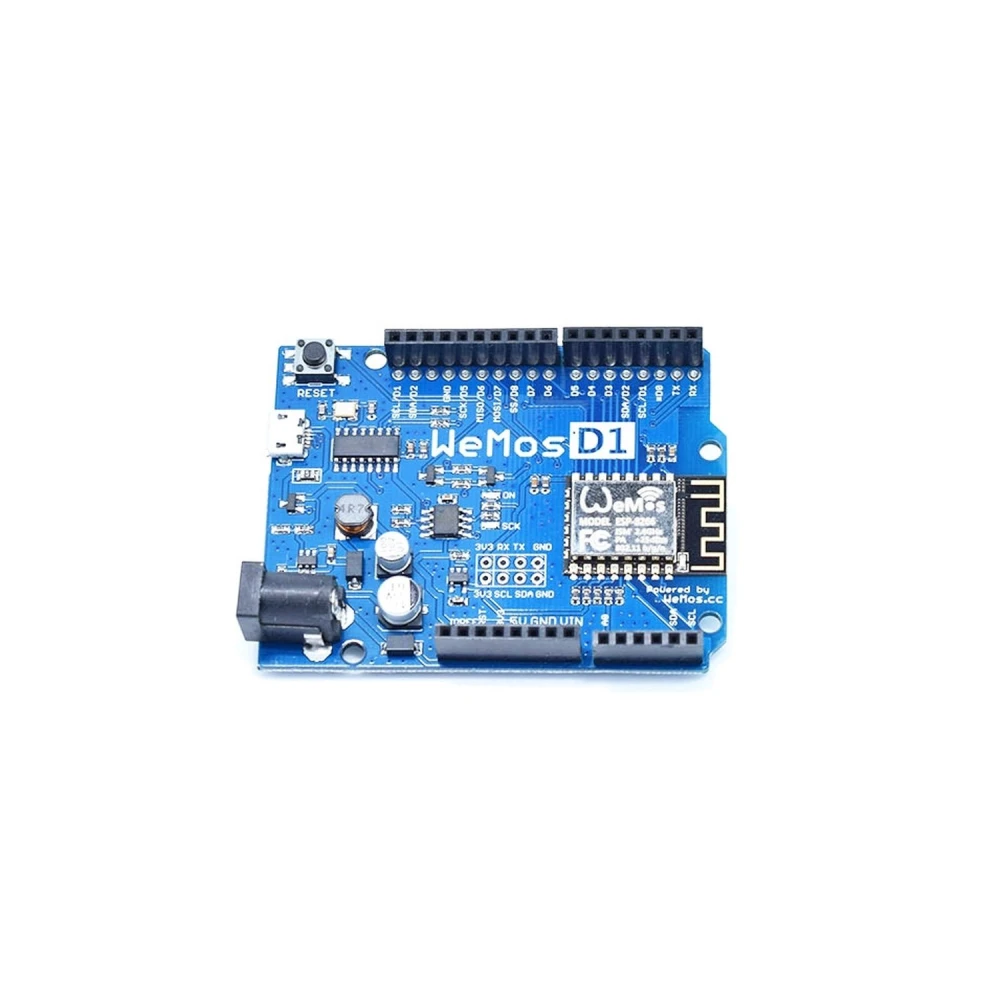
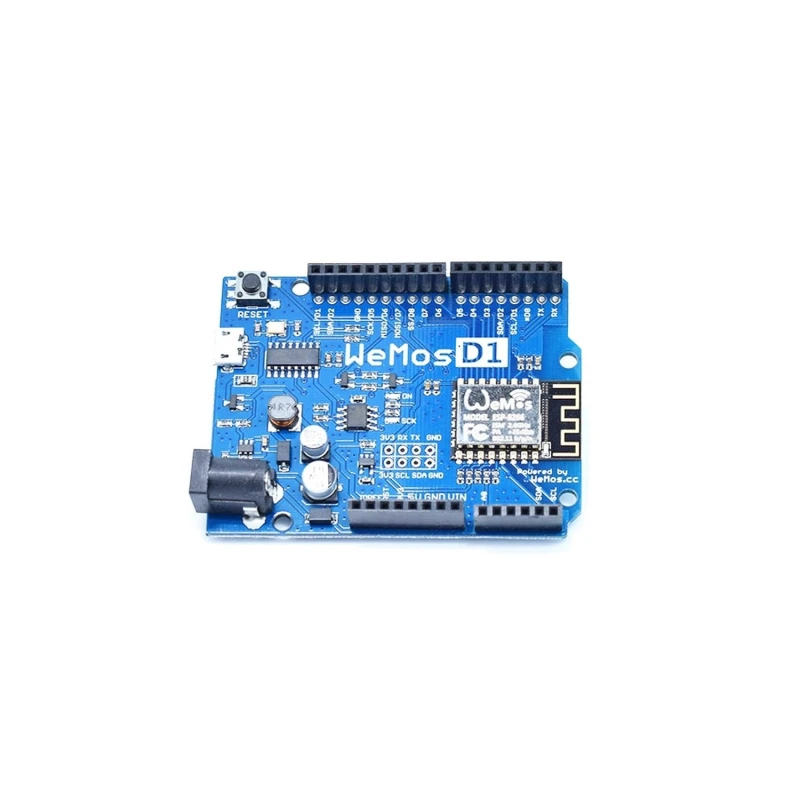
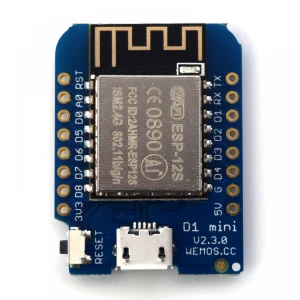
The Wemos D1 R2 WiFi ESP8266 is a mini development board based on the ESP-8266EX microcontroller, designed to provide integrated WiFi connectivity and compatibility with the Arduino Uno environment. This board is ideal for developers and hobbyists looking for a compact and efficient solution for Internet of Things (IoT), home automation and electronics projects in general.
Main features:
- Microcontroller: ESP-8266EX with integrated WiFi capability.
- Operating voltage: 3.3V.
- Digital input/output pins: 11, all with support for interrupt, PWM, I2C and One-Wire, except D0.
- Analogue input: 1 pin with a maximum of 3.2V.
- Connection: Micro USB for programming and power.
- External power: Connector for 9-24V input.
- Clock speed: 80MHz or 160MHz, configurable.
- Flash memory: 4M bytes for program storage.
- Dimensions: 68.6 mm length x 53.4 mm width.
- Weight: 25 grams.
Pin layout and functions:
- TX (TXD)
- RX (RX)
- A0: Analogue input (maximum 3.3V)
- D0 (GPIO16)
- D1 (GPIO5, SCL)
- D2 (GPIO4, SDA)
- D3 (GPIO0, 10k Pull-up)
- D4 (GPIO2, BUILTIN_LED)
- D5 (GPIO14, SCK)
- D6 (GPIO12, MISO)
- D7 (GPIO13, MOSI)
- D8 (GPIO15, 10k Pull-down, SS)
- GND, 5V, 3.3V and Reset pin (RST)
All IO pins support interrupt, PWM, I2C and One-Wire, except pin D0.
Programming and compatibility:
The board is easy to program using a Micro USB cable, which enables automatic programming. It is compatible with the Arduino IDE, making it easy to integrate into existing projects and develop new ones. It is also compatible with NodeMCU, a Lua-based firmware for ESP8266.
Typical uses:
- Developing IoT projects with WiFi connectivity.
- Automation and home automation.
- Rapid prototyping of electronic devices.
- Electronics and programming education.
Useful resources and links:
- Official Wemos D1 R2 product page
- ESP8266 Wiki
- GitHub repository for ESP8266 Arduino IDE
- ESP8266 community forum
- NodeMCU software
- CH340 USB driver
- CH340G driver installation guide
Package contents:
- 1 x Wemos D1 R2 board
- 1 x 40-pin header strip for connection
- ESP-8266EX microcontroller with integrated WiFi
- Compatible with Arduino IDE and NodeMCU
- 11 digital pins with interrupt, PWM and I2C support
- 1 analogue input with a maximum of 3.2V
- Micro USB connection and programming
- External 9-24V power input
- Configurable 80/160 MHz clock speed
- 4M bytes Flash memory
- Compact dimensions: 68.6 x 53.4 mm
- Lightweight at 25 grams
Customer Questions & Answers
What are the main functional differences between the Wemos D1 R2 and a conventional Arduino Uno board?
The Wemos D1 R2 integrates WiFi connectivity (based on the ESP8266EX chip), allowing IoT applications to be developed directly without additional hardware. It also runs at 3.3V instead of 5V, has a single analogue pin (maximum 3.2V), and offers 11 digital pins with support for PWM, interrupts and I2C communication (except D0). Although it shares a similar form factor to the Arduino Uno and is programming-compatible via the Arduino IDE, the D1 R2 is not electrically compatible with all shields due to the different operating voltages.
Are there any special considerations regarding the durability and maintenance of the Wemos D1 R2 in demanding environments?
The board is designed for indoor development; it has no IP protection or enclosure against moisture or dust. In industrial or outdoor environments it should be placed in a sealed case. The solder joints use standard solder; extreme temperature variations (>40°C, <0°C) may affect longevity. It is recommended to clean dust occasionally and avoid continuous exposure to vibration or corrosive atmospheres.
What safety standards or certifications does the Wemos D1 R2 board comply with, and which may be relevant in a professional application?
The ESP8266 module included on the board usually carries FCC (USA), CE (European Union) and RoHS (restriction of hazardous substances) certifications. However, the Wemos D1 R2 board as a whole should be considered a prototype or component, not a certified finished product. For commercial or certified applications, the certification of the final assembled system must be validated.
Is the Wemos D1 R2 compatible with the Arduino IDE?
Yes, the Wemos D1 R2 is compatible with the Arduino IDE, making it easier to program and develop projects.
What is the maximum voltage supported by the analogue input?
The analogue input supports a maximum voltage of 3.2V.
How is the Wemos D1 R2 programmed?
It is programmed using a Micro USB cable connected to the computer, with automatic programming support.
What microcontroller does the board use?
It uses the ESP-8266EX microcontroller with integrated WiFi connectivity.
Which digital pins support PWM and interrupts?
All digital pins support interrupt, PWM, I2C and One-Wire, except pin D0.
Write a customer review
Customers who bought this item also bought

-2%
-2%
Wemos D1 R2 WiFi ESP8266 - Arduino Uno Compatible Development Board
6.15 €